 4/5 stars
“But over time, I’ve come to feel that, for myself, I am glad I had kids and glad I had the kids I did, because the love for them – even at the price of this pain – has been the single greatest joy of my life. When I say that, I am speaking of my own pain, and not the pain of other people. But I accept my own pain; life is full of suffering, and this is mine. I know it would have been better for the world if Dylan had never been born. But I believe it would not have been better for me.” – Sue Klebold
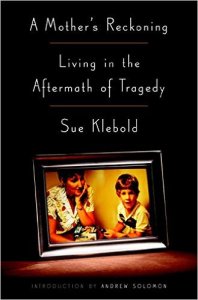
As soon as I heard about A Mother’s Reckoning: Living in the Aftermath of Tragedy by Sue Klebold, I knew I wanted to read it. I was young when the Columbine tragedy happened, but I was old enough to be deeply affected by it. I remember watching coverage of the event for a long time after, and I remember watching changes in my own life because of it. My schools practiced lockdown situations, youth in dark clothing were treated differently, and gun laws were challenged harder than ever. As dark and disturbing as school shootings inherently are, they are also fascinating from a psychological perspective. For this reason, I reserved Klebold’s book at my library and picked it up to begin reading on its release date.
The only other book I ever read on Columbine was She Said Yes: The Unlikely Martyrdom of Cassie Bernall by Misty Bernall. Cassie was a victim in the shooting, and her mother wrote the book about her daughter’s life. While Klebold’s book is also from the perspective of a mother who experienced great loss, hers is additionally an examination of a son who became a killer. Klebold’s heavy book sheds new light on the tragedy from a parent who was unaware of the war her son was fighting in his own mind. Much of what she writes is focused on mental health issues (100% of the book’s profits will go to mental health organizations) or “brain health,” as she prefers to describe it in order to make it a more tangible condition. Sixteen years after the shooting, Klebold has developed a clearer understanding of her son’s desire to die and how he used homicide as a means of suicide. With this awareness, she describes how she now uses her own painful experience to help others who are in pain – those who have survived their own suicides or suicides of loved ones.
While the book is just one glimpse into a tragedy that involved many, it seems to be a very honest and intimate look at the events leading up to, and following, two boys taking fifteen lives. Klebold includes many of her personal journal entries as windows into what she once considered a picture-perfect family life. Her son Dylan is portrayed as a quiet yet happy child who turned into a depressed teenager who primarily wanted to die; Eric Harris, the other boy involved, is portrayed as a psychopath who primarily wanted to kill and took Dylan along for the ride as a willing participant. Klebold paints two very different portraits of Dylan and Eric, and I wonder how this will be perceived. It makes me wish the Harris family would share their story, but they may never do so and that is a personal decision they have every right to make.
I also wonder how the victims’ families will react to the book (if they even read it). Klebold’s account sometimes reads as a defense strategy to take some of the blame off of her and her husband, Tom – understandably so in light of the criticism they have received. I admit, it’s easy to turn attention straight to the parents when something goes terribly wrong with a child. But, as a mother now myself, I feel for Sue Klebold. I do believe, as the book suggests, that you can do your very best and still lose a child to estrangement, criminal activity, or even death. This book is certainly a call to closely examine your family and dig deeply enough to prevent such things from happening. But not all crises can be averted despite our best efforts. The takeaway here is that a mother is still a mother no matter how she loses her child and grace and forgiveness can make a difference in the aftermath of what may be a mother’s worst possible scenario.
Regardless, Klebold is very clear about not making excuses for her son despite his mental illness. And she takes on a lot of her own guilt, as noted in this passage: “What I do know is that Dylan did show outward signals of depression, signs that Tom and I observed but were not able to decode. If we had know enough to understand what those signs meant, I believe that we would have been able to prevent Columbine.” Wow.
Release Date: February 15, 2016 (Crown)
 Disheveled Shelf
Brittney, I would likely not have chosen to read this book, for many reasons, but your review has piqued my interest.
LikeLiked by 1 person
Sue’s story is fascinating, under the worst possible circumstances of course. I liked reading the story from a side you don’t usually hear from after these events.
LikeLike